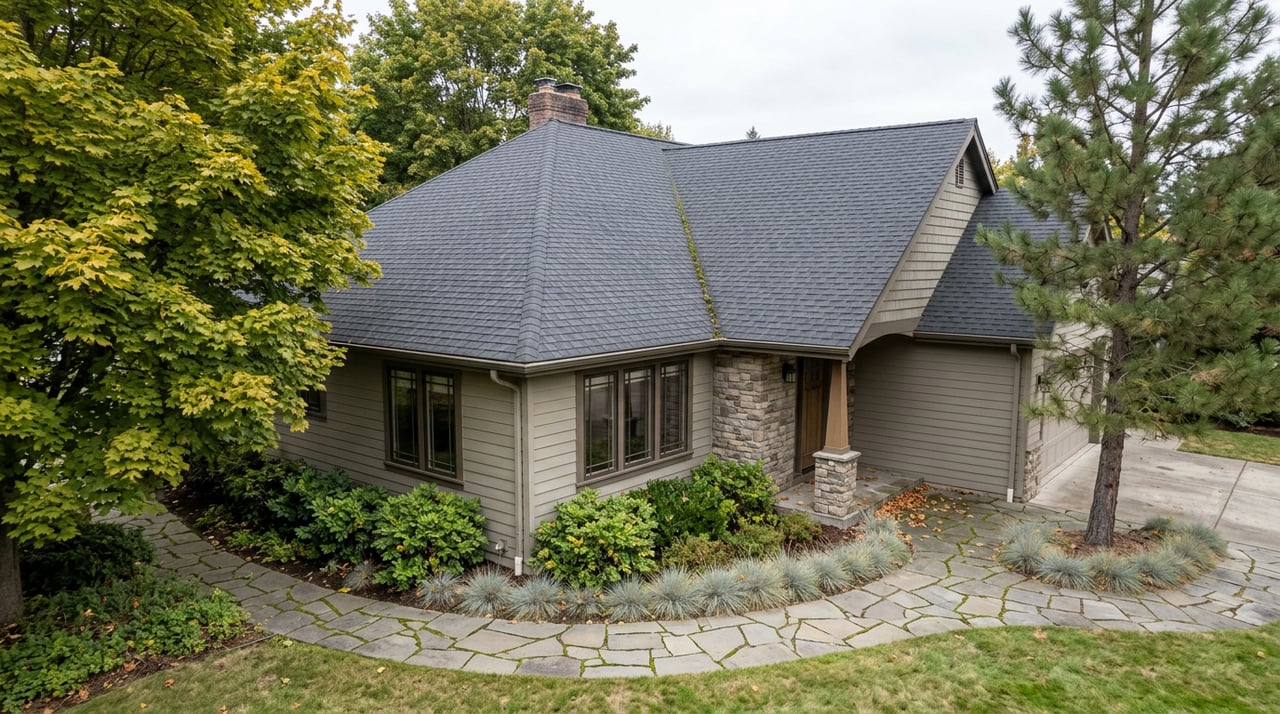
The Form 17 arrives clean. No known wiring problems. No known sewer issues. The seller has owned the 1913 Craftsman near Manito Park for eleven years and never had a reason to think otherwise. Then the sewer scope runs during the buyer's inspection period, and the camera finds a bellied section of clay pipe forty feet out, half filled with root mass. Nobody lied on that form. The seller answered honestly. The house had a problem the seller never knew existed, because nobody had ever pointed a camera down that pipe before.
This is not a story about a bad actor. It is the normal outcome of pairing a hundred-year-old house with a disclosure law that only requires a seller to report what they actually know. On South Hill, where the housing stock runs older and more varied than almost anywhere else in Spokane, that gap between "disclosed" and "true" shows up often enough that it deserves its own conversation, separate from the general old-house checklist you've read on three other sites already.
What Form 17 actually promises
Washington's Seller Disclosure Statement, better known by its form number, is required for most residential sales of one to four units under state law. It asks the seller to answer a standardized set of questions about title, water, sewer, structure, and systems, and it is built entirely around the seller's actual knowledge at the time they sign. The seller is not required to inspect the crawlspace, run a camera down the sewer line, or hire an electrician before answering. If they genuinely never looked, "don't know" is not evasive. It is the legally correct answer.
Once the seller delivers the form, typically within five business days of mutual acceptance unless the parties agree otherwise, the buyer gets three business days to review it and, in narrow circumstances, rescind the agreement. That window exists to give buyers a chance to react to what they learn. But it only works if a buyer understands what the form can and cannot tell them. A "no" means the seller didn't know it happened. A "don't know" means the seller genuinely doesn't know. Neither one is a warranty, and neither one is a substitute for a physical inspection. The form only reports what's inside the seller's head. It says nothing about what's inside the walls.
Why the gap runs wider on South Hill
Most Spokane neighborhoods have one dominant construction era. South Hill has several stacked on top of each other. Development here started in the late 1800s and continued through nearly every decade since, which is why you'll find Craftsman bungalows, Victorian-era homes, Tudor Revivals, and American Foursquares clustered in the older blocks closest to downtown, while the terrain shifts to mid-century ranchers and split-levels as you move further south and uphill, eventually giving way to newer construction in the upper South Hill developments.
That layering matters for exactly the two systems most likely to surprise a buyer mid-transaction: wiring and sewer laterals. Knob-and-tube wiring, the ungrounded, cloth-insulated wiring standard before the 1950s, is concentrated in the same pre-1930 pocket where the Craftsman bungalows and Foursquares sit, generally the lower, older blocks nearer Manito Park and the Rockwood area. Clay sewer laterals follow the same pattern, since they were the standard material for exactly that same construction window before PVC became the norm. A buyer shopping in that older, lower tier of South Hill is statistically more likely to be looking at a house with one or both of these systems still in place than a buyer looking at a home built during the neighborhood's later mid-century or new-construction phases further uphill. The median price you see on a listing doesn't distinguish between those two buyers. The construction era does.
A clean disclosure form on a hundred-year-old house is not proof of a clean house. It is proof of an owner who never had a reason to look.
The two systems that hide until escrow
Knob-and-tube wiring doesn't announce itself. It sits behind plaster and lath, visible only in an unfinished attic or basement where the ceramic knobs and cloth-wrapped conductors are still exposed. A general home inspector can flag visible signs of it, but inspectors are limited to what's readily accessible, so a home can have newer wiring in a remodeled kitchen and original knob-and-tube still running through an untouched hallway or bedroom wall. That mixed condition is common in homes that have been updated in pieces over decades rather than rewired all at once. One Spokane electrician's case file from a 1952 South Hill home describes exactly this pattern: a panel upgrade needed just to accommodate a new HVAC system, in a house that had never had a full rewire.
The financial consequence isn't only the cost of the fix. Active knob-and-tube wiring is a material fact that can affect insurance eligibility, and carriers who don't decline coverage outright often charge higher premiums to offset the perceived risk. FHA and VA loan programs, which serve a meaningful share of buyers, may also require remediation of active knob-and-tube before a loan can close. That turns a wiring question from a repair project into a financing contingency, which is a very different conversation to have mid-escrow than before you write an offer.
Sewer laterals carry a similar hidden-until-tested quality, but the diagnostic tool is a camera instead of an attic flashlight. Clay pipe, common in homes built before roughly 2000 and especially in the pre-1930 South Hill stock, typically lasts fifty to sixty years before joint failure and root intrusion become a real risk, compared with fifty to one hundred years for PVC or cast iron. Trees within twenty to thirty feet of a lateral raise that risk further, and South Hill's mature tree canopy, one of its defining aesthetic features, sits directly on top of a lot of aging clay pipe.
Here's roughly what the range of outcomes looks like once a scope actually runs:
| Finding | Typical response | Rough cost range |
|---|---|---|
| Camera inspection only | Diagnostic, no repair | $200 to $400 |
| Isolated root intrusion, one section | Spot repair or lining | $1,000 to $2,500 |
| Trenchless lining or bursting | Repairs the line without full excavation | Several thousand to low five figures |
| Full excavation and replacement | Multiple failure points or collapsed sections | Can climb well into five figures depending on length, depth, and access |
The camera inspection itself is cheap. What it finds determines everything else, and what it finds on a South Hill lateral built before 1930 is simply more likely to be a real problem than what the same camera finds on a lateral installed during the neighborhood's newer construction phases.
What this means if you're selling
If you own one of South Hill's older homes and you're thinking about listing, the honest version of Form 17 protects you either way, but a blank "don't know" next to the sewer and electrical questions invites a buyer's inspector to find the answer for you, on their timeline, during their contingency period, with leverage running in their direction. Ordering your own diagnostics before you list flips that sequence.
- Schedule a sewer camera inspection through your cleanout before your home goes on the market, so you know the lateral's condition rather than guessing at it.
- Bring in a licensed electrician for a whole-home evaluation if your home predates 1950, to document whether any original wiring is still active.
- Decide, with real information in hand, whether to make the repair, price the home to reflect its condition, or disclose the finding directly and let the buyer factor it into their offer.
Washington law also allows you to amend your disclosure statement if you learn something new during the transaction, and you're expected to pass that update to the buyer as soon as possible. A seller who discloses a documented sewer scope, clean or not, is in a stronger position than one who leaves the question blank and hopes it doesn't come up.
What this means if you're buying
A "don't know" on the wiring or sewer line questions of a South Hill Form 17 is not a green light. It's an invitation to do the diligence the seller never did. If you're under contract on a home built before 1930, particularly one in the lower, older blocks near Manito or Rockwood, treat a sewer scope and an electrical evaluation as standard parts of your inspection period rather than optional add-ons. Both are inexpensive relative to what they can reveal, and both give you a factual basis for renegotiation instead of a guess.
If the scope comes back clean, you've bought certainty for a few hundred dollars. If it doesn't, you're negotiating from actual findings rather than the seller's incomplete knowledge, and that difference is worth more than the cost of the inspection itself.
FAQ
Does the seller have to pay for a sewer scope before listing? No. Washington's disclosure law doesn't require a seller to conduct any new inspection. A pre-listing scope is a choice, not a legal obligation, though it often strengthens a seller's position.
Who is responsible for the sewer lateral, the homeowner or the city? In most Spokane-area jurisdictions, the homeowner is responsible for the line running from the house to the point where it connects to the municipal main. The city is generally responsible only for problems in the main line itself, and the City of Spokane requires a permit before any sewer line replacement work begins on the private side.
If a home inspector doesn't flag knob-and-tube wiring, does that mean it isn't there? Not necessarily. Inspectors report what's visible and accessible. Wiring behind finished walls and ceilings can go undetected in a general inspection, which is why a focused electrical evaluation is worth the extra step on any pre-1950 home.
South Hill's mix of eras is exactly what makes it one of Spokane's most distinctive places to own a home, and it's also exactly why a disclosure form here needs to be read with more care than a form on a five-year-old build in a newer subdivision. If you're weighing a purchase or a sale on South Hill and want a clear read on what a specific property's age actually means for your inspection period, Gayle Terry and the team at The Collection offer a complimentary consultation and home valuation to walk through exactly that.