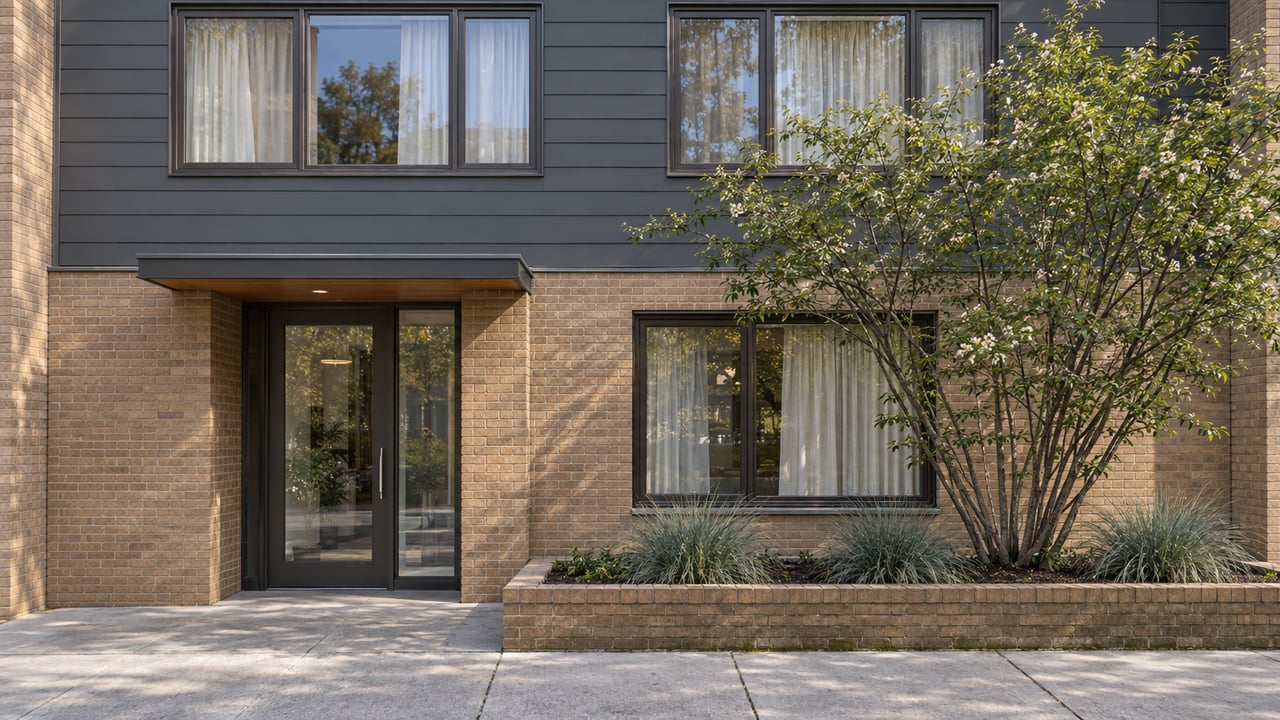
Kendall Yards is under more construction right now than almost any other pocket of Spokane. A six-story building with 200 units is headed for the last visible vacant lot on Summit Parkway. Two more buildings are already framed up on the neighborhood's southern hillside. Greenstone Corp, the developer that has built most of Kendall Yards, says the district is about 60 percent finished, with roughly 17 acres left to develop where the Spokane River bends into Hangman Creek.
None of that construction will put a new home on the market for someone who wants to buy rather than rent. The project headed for Summit Parkway and the buildings going up on Ohio and Falls are apartments. That distinction, not the neighborhood's growth rate, is why Kendall Yards has kept its ownership prices climbing even as home values across the rest of Spokane sat flat.
Two Buildings, Zero Homes for Sale
In July 2026, Greenstone submitted a construction application for the last major undeveloped lot west of the Monroe Street bridge, according to the Spokesman-Review. The proposal calls for a six-story, $71 million building with 200 residential units, 364 parking stalls, and 53,000 square feet of ground-floor space for restaurants and retail, plus a rooftop lounge over Spokane Falls. The industry has nicknamed it the Podium project since 2017, after the public events venue built nearby in 2020. A city council member called the proposal a win for a lot that has sat empty for years. As of the July filing, construction had not started.
Half a mile south, on a quarter-acre bought for $400,000 in December 2025, Spokane builder David Tucker broke ground in April 2026 on a $4 million project called The Ohio: two three-story buildings holding 12 units total, one on Ohio Avenue and one on Falls Avenue, both about 400 feet from the river and just south of the Centennial Trail, according to the Spokane Journal of Business. The buildings are expected to open in early 2027, with Spokane Valley-based Hornberger Property Management set to run them once complete.
That's 212 new residences headed for Kendall Yards over the next year, and not one of them will show up as a listing.
The Law That Decided What Gets Built
The reason isn't a lack of buyer demand. It's a set of state laws that made condominiums the riskiest thing a Washington developer could build.
Washington's condominium statutes trace back to the 1980s and 1990s, when a wave of poorly built condos across the state developed leaks and mold problems. Owners sued, and won, in numbers large enough that insurers either left the condo market entirely or priced coverage out of reach for smaller projects. Lawmakers layered on stronger consumer protections through the following decades, and the liability standard for a condo building ended up well above what applies to an apartment building or a single-family subdivision built with the same materials and the same crews. Insurance costs and legal exposure got high enough that most developers stopped building condos altogether, and the ones who still did passed the added cost straight into the sale price.
Statewide, condos make up about 5.3 percent of Washington's housing stock but have accounted for 1 percent or less of new construction since 2011, according to a summary of the reform legislation from the Housing Development Consortium. Greenstone felt that math directly. Company leadership was reportedly exploring the feasibility of small condo buildings in Kendall Yards as recently as November 2025, tying the interest specifically to the prospect of looser liability rules, exactly the caution the statewide numbers would predict from a builder facing that exposure.
A Fix That Doesn't Reach the Big Parcels
Washington has been trying to unwind this for two legislative sessions running, and the fixes are real, just narrow.
House Bill 1403 took effect in July 2025 and gave some condo developers an alternative to the old implied-warranty standard, an insured express warranty instead. It excluded stacked flat condos over two residential floors, which ruled out the kind of walk-up building common in urban infill. Senate Bill 5334, signed into law on April 30, 2026, went further. It raised the bar for what a condo owner can sue over, requiring proof that a defect violates an actual building code and causes real harm rather than a technical infraction, and it shielded HOA board members from personal liability for choosing not to sue. House Bill 2304 passed the legislature that same session and was signed on March 9, 2026, widening the express-warranty option to more building types.
As of June 2026, the expanded warranty option applies to condo buildings of 12 units or fewer and four stories or fewer.
That ceiling matters for Kendall Yards specifically. The building headed for Summit Parkway is six stories and 200 units. Even under the new law, a building at that scale would still fall under the older, stricter warranty framework that made condos expensive to insure in the first place. The reform reaches a building like The Ohio. It doesn't reach the parcel the neighborhood's biggest remaining development is actually using.
What the Numbers on Summit Parkway Show
Citywide, Zillow's home value index put the typical Spokane home at $404,211 as of July 31, 2026, down 0.2 percent from a year earlier. Kendall Yards moved the opposite direction. Its median sale price reached $645,000 in January 2026, up 5.7 percent from the year before, and by early August 2026 only four homes were listed for sale in the entire neighborhood, at a median asking price of $757,500.
Those four listings had also sat on the market for an average of 76 days, longer than the roughly 30-day county-wide average in mid-2026. That gap doesn't mean demand in Kendall Yards is weak. It means the sample is small enough that a single overpriced or oddly configured unit can drag the average out for months while everything else the neighborhood could plausibly want sells quickly. With a handful of listings driving the whole statistic, days-on-market stops measuring buyer interest and starts measuring the luck of what happens to be on the market that week.
That's the gap worth holding onto when comparing Kendall Yards to other Spokane neighborhoods. The rental pipeline keeps expanding, and the neighborhood keeps adding the kind of amenity base that draws people in, including a Wednesday night market on Summit Parkway that pulls up to 6,000 visitors a week through the end of September. None of that amenity growth adds a for-sale unit. Every renter competing for space in a growing apartment stock is one more person who might eventually want to buy into a supply that state law has kept narrow for two decades running.
FAQ
Will any of the new apartment buildings ever convert to condos? Nothing in the current filings for the Summit Parkway project or The Ohio mentions a condo conversion, and a six-story building of that scale would still fall outside the size limits the 2026 reform covers even if an owner considered it later.
Does the 2026 condo law change mean new condos are coming to Kendall Yards soon? It makes a small building, 12 units or fewer and four stories or fewer, more financially workable for a developer than it was a year ago. Kendall Yards' remaining large parcels are being used for buildings well above that size, so the reform is more likely to show up first on smaller infill lots than on the neighborhood's marquee sites.
Is Kendall Yards still worth considering if inventory is this tight? The tightness is real, and it changes the strategy more than the answer. A buyer who wants ownership in this neighborhood is working from a pool that can be counted on one hand at any given time, which puts more weight on being ready to act the moment something new appears than on waiting for a construction boom to bring prices down.
If you're weighing Kendall Yards against another Spokane neighborhood and want a clear read on what's actually available to buy right now, not just what's under construction, The Collection can walk you through the current ownership inventory and what it takes to compete for it. Request a complimentary consultation and home valuation.